Opening chapter · Lines That Feel · Love, suffering, and eternity
The Starry Night: Where the Question Begins
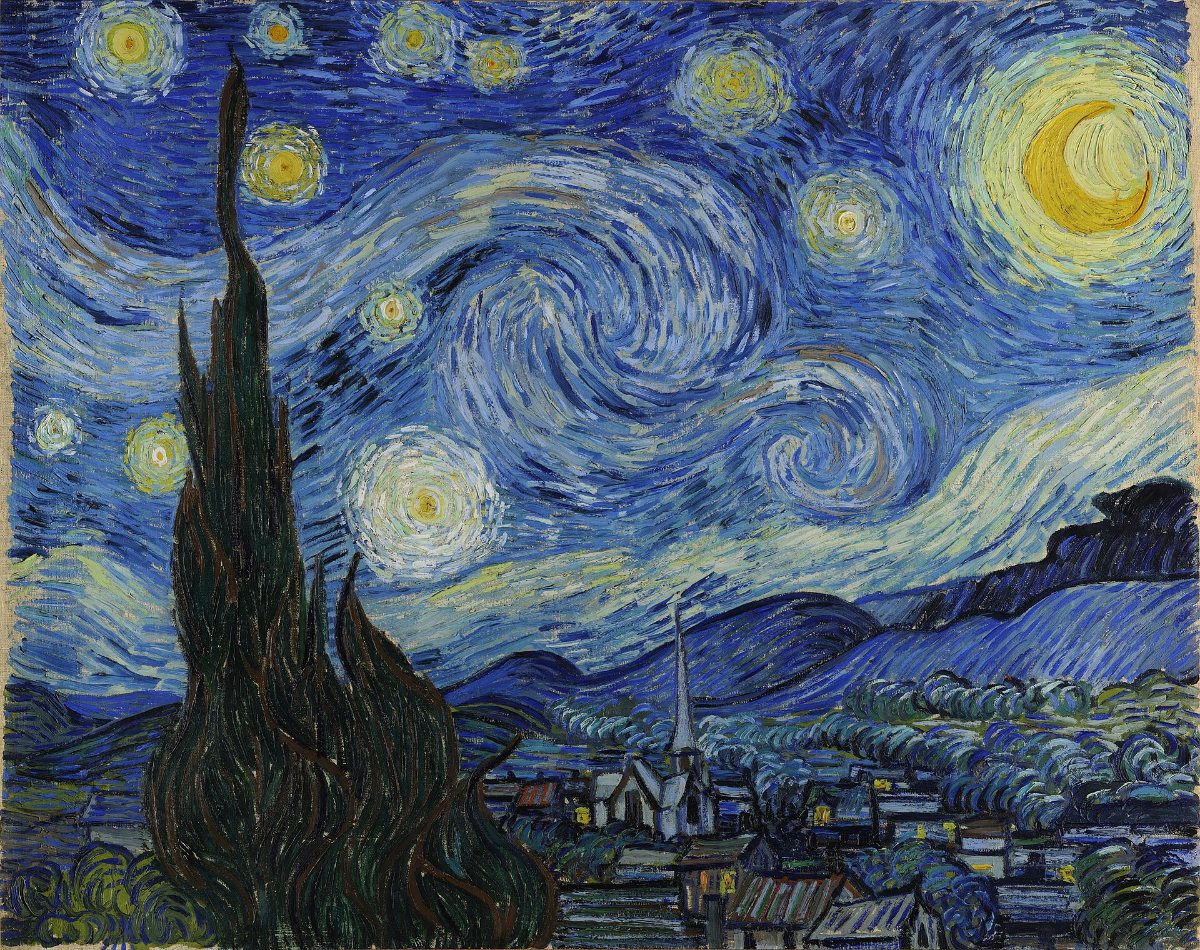
A village sleeps. A cypress reaches upward. Above them, the sky refuses to be still. This exhibition begins here with one question: can love carry us through suffering and point toward eternity?
Begin with the question, not the answer
Can love carry us through suffering and point toward eternity?
The painting does not hand us an easy answer. The sleepy village and the swirling sky hold opposites in one picture: calm and restlessness, dark and light, feeling alone and feeling connected, the ground under us and something far beyond it.
The question belongs to the whole exhibition. It will return in Vincent's portraits of friends, in his thoughts about faith, in the care he received during crisis, and finally in the ways young artists transform what they have seen.
First, look at what your eyes can prove
- The village is still. Roofs, walls, and the church spire settle into short, firm shapes.
- The cypress reaches. Its dark vertical form links the ground to the moving sky.
- The sky travels in curves. Clouds, wind, and light turn into long waves and spirals.
- The stars push outward. Rings of pale colour make each point of light feel larger than its place on the canvas.
- Blue is not empty. Deep blue, green-blue, violet, white, and yellow build a night full of energy.
These are not background decorations. Line, colour, rhythm, and contrast carry the emotion of the picture before a label explains anything.
A real night, transformed
Van Gogh painted The Starry Night in Saint-Rémy in 1889, while living at Saint-Paul-de-Mausole after a period of serious mental crisis. Van Gogh really did look at this landscape — but then he rebuilt it into a painted world of his own. It is not a photo of one moment. It is what he saw, what he remembered, what he imagined, and what he felt, all mixed into one picture.
That difference matters. A swirl in the sky does not tell us what was wrong with Vincent, and pain is not a magic ingredient for art. What we can say for sure is simpler: he chose every line and colour on purpose — and those choices let you feel stillness and movement at the same time.
Why do the stars lead toward eternity?
Before he painted this work, Vincent had already used the stars to think beyond ordinary distance. In Letter 638, written in July 1888, he wrote:
“The sight of the stars always makes me dream.”
In the same passage he wondered whether a painter might continue speaking to future generations through a work of art. He did not claim certainty. The importance is the wondering: the night sky became a place where distance, death, hope, and continuing relationship could be thought about together.
Why does an exhibition about stars begin with love?
After Vincent's crisis in Arles in December 1888, care was not only an idea. In Letter 729, written on 4 January 1889, Vincent told his brother that while he was in hospital, the cleaning lady and his friend Joseph Roulin had looked after the Yellow House and tidied it up for him.
This evidence does not prove that Roulin caused The Starry Night, or that every friend played the same role. It gives the exhibition a more honest starting point: when someone is suffering, love often looks very ordinary — showing up, helping out, putting a broken world back in order.
Vincent's portraits of Roulin and Eugène Boch will let us meet two people he valued. The starry paintings ask a different but connected question: can a relationship, a memory, or a work of art reach beyond the moment in which it was made?
Faith, but not an easy answer
Vincent grew up with Christianity, and for years he wrestled with one question: where can the holy be found? His paintings never turn that struggle into a tidy answer. A church sits in the sleeping village — but the biggest light and movement are outside its walls.
That opens a question instead of closing it: does the eternal live only inside a church, or can you also meet it in a night sky, a field, a friend's kindness, an ordinary worker — or a painting made for people not born yet?
Your turn
- Where does your eye go first: the cypress, the village, the spiral, a star, or the moon?
- Which lines feel peaceful? Which feel restless or alive?
- Does the sky feel frightening, hopeful, infinite, or something else?
- What changes when you imagine the painting as a question about love and eternity?
- If you could turn one feeling into a line, what kind of line would you make?
Artwork facts
- Artist
- Vincent van Gogh
- Title
- The Starry Night
- Date
- 1889
- Material
- Oil on canvas
- Size
- 73.7 × 92.1 cm
- Collection
- Museum of Modern Art, New York