Mr Yancy's Class Room · Wall 01
Pixels: From Dots to Form
This Live Painting begins with almost nothing: one tiny mark on a black field. Watch carefully. Size, color, position, and relationship turn simple pixels into pictures, surfaces, and forms that appear to have depth.
- Smallest mark
- 1 px
- Point–line–plane
- 1,260 px
- 3D model
- 2,400 faces
- Shared edges
- 4,060
01 · Size
A pixel can take on a visual role.
The first field compares marks in three zones. Circles on the left grow from 1 px to 2 px and 3 px. The center uses 8 px triangles. The right uses 12 px squares. They remain separate so differences in weight, rhythm, and falling motion are easy to see.
The larger symbols are still built from pixels. “Circle,” “triangle,” and “square” are shapes our eyes recognize after pixels occupy the right positions.
02 · Picture
Random dots become a picture.
At first the coloured dots fly around on their own. Then all 2,309 of them land on spots copied from a photo of a galaxy. One dot by itself tells you almost nothing; the arrangement is what holds the picture. When the positions are released, the picture falls apart and disappears.
03 · Dimension
Points suggest lines; lines enclose planes.
In this scene, 1,260 one-pixel marks gather more precisely. A dense group reads as a point. Ordered rows read as a line. Connected lines define the edge of a triangular plane. Nothing new was added—the pixels only changed their relationships.
04 · Form
How can flat triangles look three-dimensional?
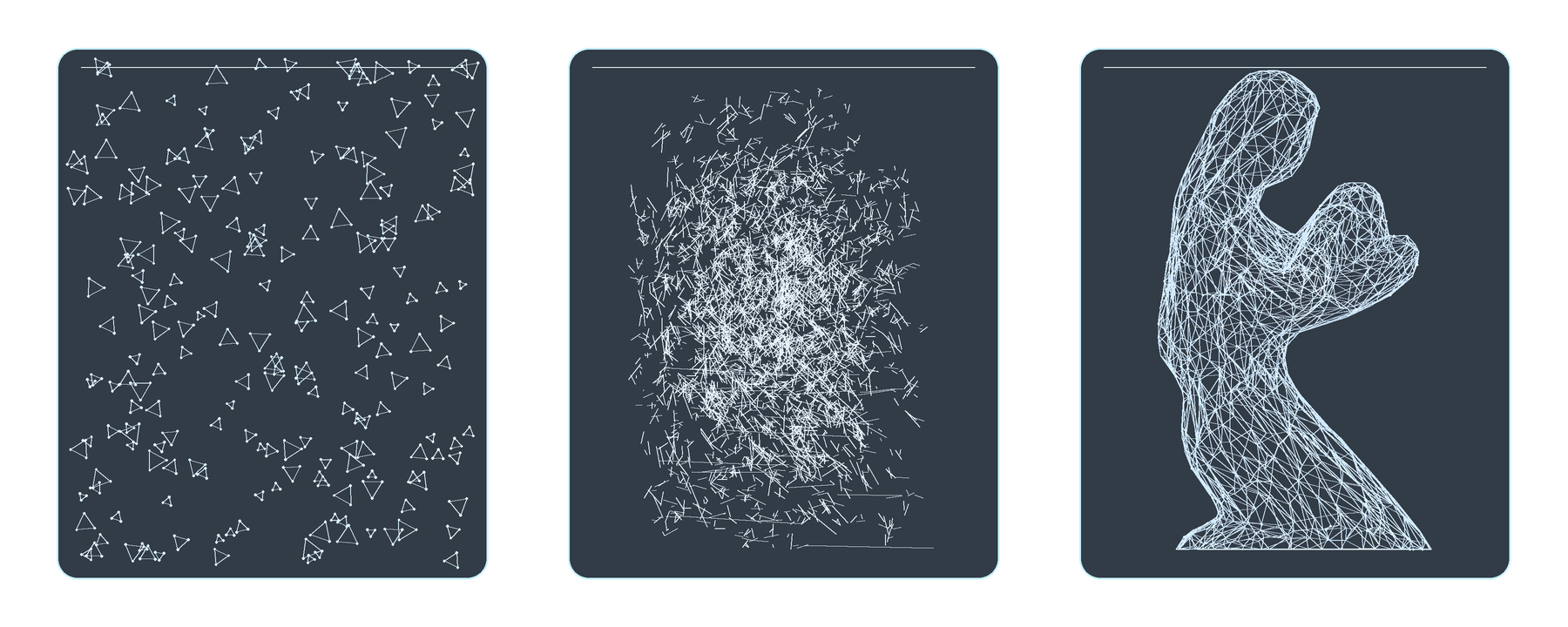
One triangle is flat. But thousands of triangles can build a solid-looking shape — when they share edges, tilt in different directions, overlap, and shrink as they get farther away. The near edges are drawn bright and the far ones faint, like an X-ray. Your eyes read those clues and see a solid object.
05 · Transform
The same structure can become another form.
The last part plays slowly so you can watch every change: a boxy cube softens into a rounded cube, then into a ball. Its four-sided tiles split into triangles, so the surface gets smoother. Then the triangles scatter — and gather again as the Madonna and Child.
Digital modeling is not magic. It is a series of understandable choices about points, connections, surfaces, transformations, color, and time.
Do not be intimidated by a complex image or model. It may simply be many small pixels changing together—and so form other things.