Second chapter · Lines That Feel · Love, suffering, and eternity
Painting the People He Loved
Van Gogh painted friends and neighbors with a tenderness often reserved for saints. He gave ordinary people glowing color and starry backgrounds, as if to say: this person matters; this person is holy.
The moment you were loved, kept forever
Begin with a small, strange fact. On an ordinary afternoon in Arles in September 1888, a man sat still in a yellow jacket while his friend painted him. Both of them have been dead for a century. The afternoon is still here.
That is what a portrait is. Not a photograph of a face — a record that somebody was worth the hours. Vincent did not paint these two men because they were important. He painted them because they were his, and the loving is the part that got written down.
He knew what he was reaching for, and he said so three weeks before he found anyone to sit for him. In Letter 663 he described a picture he had not yet made:
“Behind the head — instead of painting the dull wall of the mean room, I paint the infinite.”
The wall of that room was real, and it was dull. The infinite was not there. He decided to put it there, behind an ordinary head, before he even knew whose head it would be.
And the record held. Eugène Boch kept his own portrait for the rest of his life — through two wars, fifty-three years — and left it to the French state when he died in 1941. The afternoon somebody loved him is hanging in Paris this morning.
Lucas Academy reads this chapter with one conviction of its own. It belongs to the school, not to Vincent, and the paintings do not prove it. It is this: of everything a person builds, love is the part that lasts — which is why one moment of being loved is worth a whole sky behind it.
“And now these three remain: faith, hope and love. But the greatest of these is love.”
So before you read anything else here, answer the question the rest of this page keeps asking, in its smallest form: when did you know that somebody loved you? Hold on to that one moment. You will be asked, further down, what you would put behind it.
Who is worth painting?
Who is worth painting — and what does a painter have to see before the painting begins?
Chapter one asked whether love can carry us through suffering and point toward eternity. Here the same question loses its big words and becomes an ordinary one. In Arles, across the summer and early autumn of 1888, Vincent answered it twice: he painted the man who handled the mail at the railway station, and he painted a friend who was about to leave town.
Neither man was famous. Neither was paid to sit. What each was given instead was attention — hours of it — and, in one case, a sky.
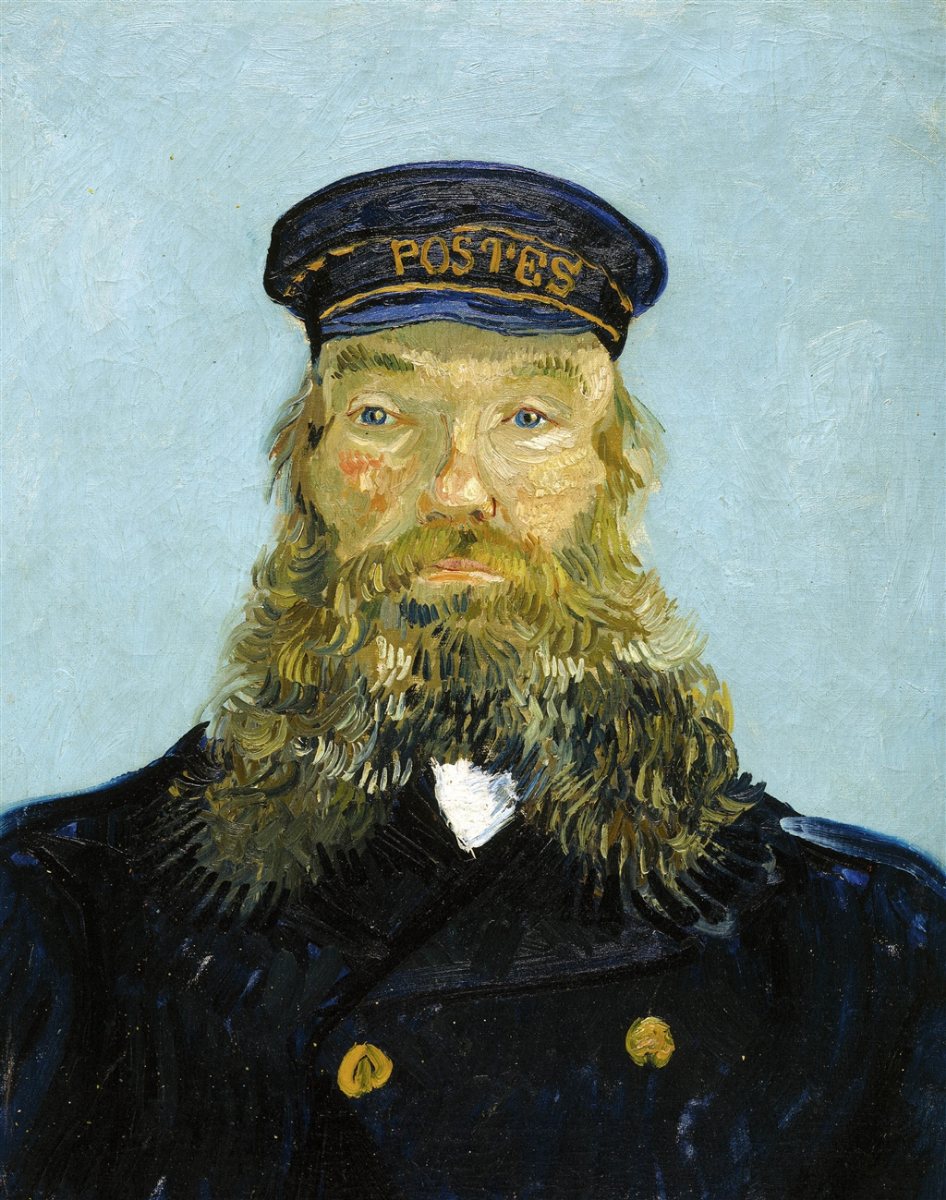
A friend painted like family: the great beard, kind eyes, and uniform worn with pride.
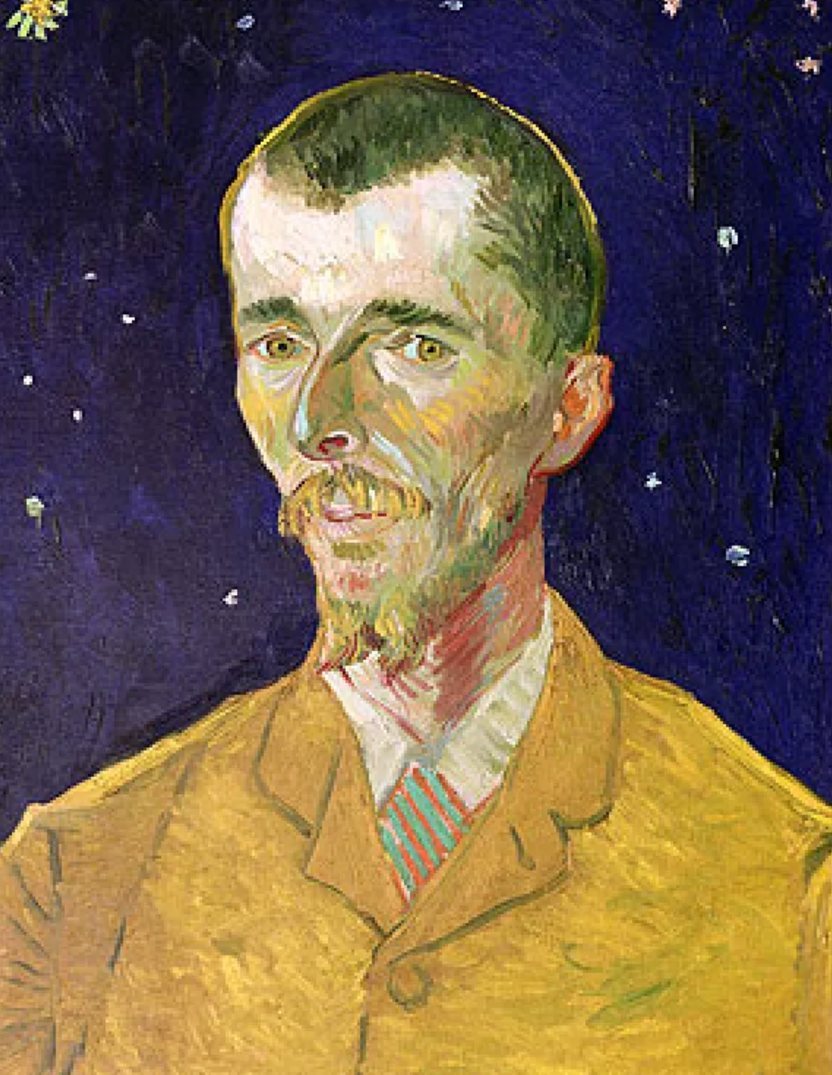
Vincent painted his friend against a deep blue sky full of stars — as if lifting an ordinary person up into forever.
First, look at what your eyes can prove
- A face, and nothing else. No desk, no letters, no pen, no props to explain who these men are. The person is the whole subject.
- The uniform gets the care a face gets. Dark blue cloth, gold buttons, and POSTES lettered in gold across the cap — working clothes painted as slowly as the eyes above them.
- One background is a wall; the other is a sky. Roulin sits in front of flat pale blue. Boch stands in front of deep ultramarine scattered with small stars.
- The skin is not skin-colored. Boch's face is built from green, yellow and pink; the head reads as lit rather than described.
- Both heads are large, close, and pushed forward. They fill the canvas. You are standing near enough to speak to them.
These are choices, not accidents. Before any label explains anything, the size of a head, the care spent on a collar, and the color behind it have already told you what the painter thought this person was worth.
The postman was not quite a postman
Joseph Roulin did not carry letters from door to door. He was an entreposeur des postes at the railway station in Arles — the man who received and dispatched the mail where it arrived. Vincent called him the postman anyway, and painted the uniform that said so.
He met him in the summer of 1888. In Letter 652, written to his brother Theo on 31 July, the whole description is four short sentences:
“Now I'm working with another model, a postman in a blue uniform with gold trimmings, a big, bearded face, very Socratic. A raging republican, like père Tanguy. A more interesting man than many people.”
That last line is the hinge of this chapter. A more interesting man than many people. Not a great man, not a holy man — an interesting one, worth looking at, worth the paint.
Vincent did not stop at one portrait, or at one Roulin. Over roughly a year he painted the whole family: Joseph, his wife Augustine, their sons Armand and Camille, and the baby Marcelle — around two dozen canvases of five people who lived nearby. No duke commissioned them. Nobody was going to buy them.
And the friendship ran the other way too. Chapter one records what happened after Vincent's crisis in Arles: in Letter 729, on 4 January 1889, he told Theo that while he was in hospital the cleaning lady and Roulin had looked after the Yellow House and tidied it up for him. The man he had painted a dozen times went and swept his floor.
The sky was decided before the friend arrived
The second portrait has an unusual history: we can read the plan for it three weeks before it was painted. On 18 August 1888, in Letter 663, Vincent described to Theo a picture he had not yet made, of a friend he had not yet persuaded to sit:
“Behind the head — instead of painting the dull wall of the mean room, I paint the infinite. I make a simple background of the richest, most intense blue that I can prepare, and with this simple combination, the brightly lit blond head, against this rich blue background achieves a mysterious effect, like a star in the deep azure.”
Read that again slowly. The wall of the room is real and it is dull. The infinite is not there — he decides to put it there. The background was chosen before the sitter was.
The sitter turned out to be Eugène Boch, a Belgian painter who was about to leave Arles. He posed at the beginning of September, and on the 3rd, in Letter 673, Vincent told Theo it had finally happened:
“Ah well, thanks to him — at last I have a first sketch of that painting I've been dreaming about for a long time — the poet. … His fine head, with its green gaze, stands out in my portrait against a starry, deep ultramarine sky; his clothing is a little yellow jacket, a collar of unbleached linen, a multicoloured tie.”
Every item in that sentence is still in front of you: the green gaze, the starry ultramarine, the yellow jacket, the unbleached collar, the striped tie. One detail is worth knowing before you decide what the picture means. Boch was a painter, not a poet. The Poet is what Vincent called the painting, not what the man did for a living — a title given the way a nickname is given, by someone who has decided what he sees in you.
What a halo used to be for
For centuries European painters marked a holy person with a flat disc of gold behind the head. You knew who mattered because the gold told you. In the same Letter 673, Vincent wrote down what he wanted instead:
“I'd like to paint men or women with that je ne sais quoi of the eternal, of which the halo used to be the symbol, and which we try to achieve through the radiance itself, through the vibrancy of our colorations.”
So the gold disc is gone, and the job it did is handed to color. A blue so intense it stops being a wall. A yellow jacket that glows against it. Chapter three will show the same move made once more, out of doors, where a farmer scatters seed under a sun that sits behind his shoulders exactly where a halo would be.
What has changed is who gets one. The disc used to be for saints. Vincent gives the treatment to a friend leaving town, and the same long looking to a man in a post-office cap.
What the pictures prove, and what they do not
You cannot see friendship in a painting. A brushstroke does not testify that anybody was loved.
What the evidence does show is narrower, and enough: he chose these sitters when nobody asked him to, he spent that many hours on them, he wrote those sentences about them at the time, and when he was in hospital one of them came and tidied his house. The claim this chapter adds — that giving the eternal to a postal worker is a statement about what a person is worth — is the exhibition's reading, not Vincent's proof.
He left his own version open. Roulin was a fierce republican; Vincent was a pastor's son who had stopped preaching. Whether painting an ordinary man like a saint is a religious act, a political one, or simply what love looks like when a painter does it, the two pictures do not say. They only insist on the first step, which is harder than it sounds: look at this person for a long time.
Your turn
- The moment you were loved. Think of one — a real one, a small one. What goes behind it: a quiet wall, a night sky, a sun, or gold? Whatever you choose, you are saying what that moment was worth.
- Vincent spent as long on the postman's cap as on his face. What does someone you love wear every single day?
- No props are allowed — no phone, no ball, no pet. What is left to show who a person is?
- Think of a person you see every day and have never once looked at for a whole minute. What would you have to notice before you could paint them?
- Somebody, some day, tidied up your house when you could not. Who is that, and what would their portrait need?
The Postman — Joseph Roulin
- Artist
- Vincent van Gogh
- Date
- August 1888, Arles
- Material
- Oil on canvas
- Size
- 64.1 × 47.9 cm
- Collection
- Detroit Institute of Arts (acc. 1996.25)
The Poet — Eugène Boch
- Artist
- Vincent van Gogh
- Date
- September 1888, Arles
- Material
- Oil on canvas
- Size
- 60 × 45 cm
- Collection
- Musée d'Orsay, Paris
One last fact
Eugène Boch kept his portrait. He carried it through two wars and fifty-three years, and when he died in 1941 he left it to the French state; it hangs today in the Musée d'Orsay. The painting that put an ordinary man under the stars stayed with that man his whole life.